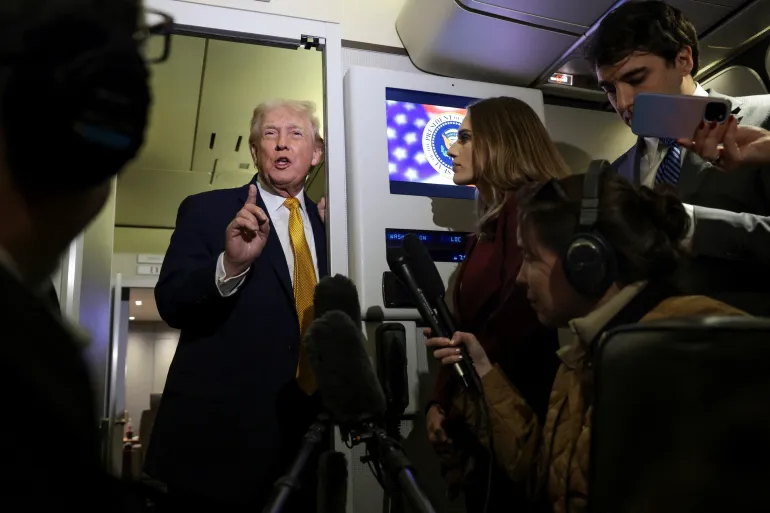
Donald Trump said on Monday that he will personally oversee US involvement in Venezuela after the arrest of Nicolas Maduro, ruling out early elections and outlining plans to stabilise the Country.
His comments come as Venezuela swore in an interim president and Maduro appeared in New York to face federal drug trafficking charges.
This comes few days following the capture of long-time leader Nicolás Maduro in a surprise U.S. military operation.
Washington says the move targets drug traffickers and criminal networks, not the Venezuelan state.
President Donald Trump said he will personally oversee U.S. involvement, arguing the country must first be stabilized before elections can occur.
He cited the need to rebuild institutions, restore oil infrastructure, and prevent criminal networks from exploiting the transition period.
Speaking to NBC News, US President made clear that ultimate authority rests with him. Asked who would be in charge of the US effort, the president replied, “Me.”
He said he had assembled a team of senior officials to manage different aspects of the operation, including Vice President JD Vance, Secretary of State Marco Rubio, Defense Secretary Pete Hegseth and White House deputy chief of staff Stephen Miller.
“It’s a group of all. They have all expertise, different expertise,” he said.
Trump ruled out holding elections in Venezuela in the next 30 days, arguing that the country must first be stabilised after years of political and economic upheaval.
“We have to fix the country first. You can’t have an election. There’s no way the people could even vote,” he said.
He added that recovery would take time, saying, “No, it’s going to take a period of time. We have to nurse the country back to health.”
The president also outlined plans that could see the United States subsidise major repairs to Venezuela’s oil infrastructure, suggesting an 18-month effort led by energy companies.
“I think we can do it in less time than that, but it’ll be a lot of money,” Trump said. He added. “A tremendous amount of money will have to be spent and the oil companies will spend it, and then they’ll get reimbursed by us or through revenue.”
Despite the military operation that led to Maduro’s arrest, Trump insisted the US was not at war with Venezuela.
“No, we’re not,” he said, describing the mission instead as a fight against drug traffickers and criminal networks.
“We’re at war with people that sell drugs. We’re at war with people that empty their prisons into our country and empty their drug addicts and empty their mental institutions into our country.”
Trump also warned that the US was prepared to intervene again if cooperation from Venezuela’s new leadership was not forthcoming.
“We’re prepared to do it. We anticipated doing it, actually,” he said, though he added that he did not believe a second incursion would be necessary.
While saying he had not personally spoken to Delcy Rodríguez, Trump noted that Marco Rubio speaks to her fluently in Spanish and that their relationship has been very strong.
In Caracas, Venezuelan authorities moved quickly to project an image of continuity and independence following Maduro’s arrest.
Lawmakers aligned with the ruling party, including Maduro’s son, gathered in the capital to proceed with a scheduled swearing-in ceremony of the National Assembly, whose term will run until 2031.
Delcy Rodríguez, who served as Vice President under Maduro and has said she will work with the Trump administration, was sworn in as interim president.
Taking the oath administered by her brother, Jorge Rodríguez, who was reelected as speaker, she said, “I come with sorrow for the suffering inflicted upon the Venezuelan people following an illegitimate military aggression against our homeland.”
Meanwhile, in New York City, Maduro appeared in federal court after being seized by US forces in a surprise raid at his Caracas home.
He declared himself “the president of my country” as he protested his capture and pleaded not guilty to federal drug trafficking charges. His wife, Cilia Flores, who was detained during the same operation, also pleaded not guilty.
US officials described the case as the most significant prosecution of a foreign head of state in decades, unfolding alongside what Trump has openly described as a regime change that will allow his administration to run Venezuela.
Trump said lawmakers were aware of the operation, stating, “We have good support congressionally.” He added that Congress knew what was planned, though he declined to give details, saying, “I don’t want to get into that, but people knew.”
The developments mark a pivotal moment for Venezuela, with its political future now unfolding under intense international scrutiny and direct US involvement.































Comments
Sign in with Google to comment, reply, and like comments.
Continue with Google